


Oman is the cheapest of the six Gulf states to live in and the UAE is the most expensive, by a wide margin. On September 2026 price data, a single person renting a one-bedroom flat outside the city centre needs about USD 1,330 a month in Muscat and USD 2,650 in Dubai. A family of four renting a three-bedroom flat outside the centre needs about USD 3,930 in Muscat and USD 6,980 in Dubai, before school fees. Rent accounts for most of the difference.
The ranking carries three conditions. Pay differs across the Gulf as much as prices do, so the cheapest city is not always the one where you keep the most. School fees sit in a narrow band across the six cities whatever local rents are, which reshuffles the middle of the table for families. And 2026 has been an unusual year for prices: rents are softening in Dubai and Doha, Riyadh has frozen them, and food and transport costs are rising faster than headline inflation suggests.
How the figures were built
Each country is represented by one city: Dubai, Riyadh, Doha, Muscat, Manama and Kuwait City. Prices come from Numbeo’s city pages for Dubai, Riyadh, Doha, Muscat, Manama and Kuwait City. Each page was read in full on 25 September 2026, and the last update on each falls between 2 and 23 September.
Numbeo is crowd-sourced, so every figure is an estimate. In the past 12 months Dubai’s page drew on 1,738 entries from 298 contributors, Riyadh’s on 1,023 entries from 119, Doha’s on 994 from 105, Muscat’s on 738 from 62, Manama’s on 490 from 42 and Kuwait City’s on 228 from 39. The thinner the sample, the more one unusual entry can move a number, so Kuwait and Bahrain are the least certain rows. Numbeo says it mostly uses data no more than 12 months old, and up to 24 months where contributors are few, so it can trail recent price moves (Numbeo methodology).
Two households are modelled. The single person rents a one-bedroom flat outside the city centre and spends Numbeo’s single-person estimate excluding rent. The family of four rents a three-bedroom flat outside the centre and spends Numbeo’s family-of-four estimate excluding rent. Numbeo does not say whether that family estimate includes school fees, so this guide keeps schooling separate and adds it in its own section.
Amounts are converted to US dollars at the fixed dollar pegs for the dirham (AED 3.6725), Saudi riyal (SAR 3.75), Qatari riyal (QAR 3.64), Omani rial (OMR 0.3845) and Bahraini dinar (BHD 0.376), and at the rate Numbeo’s own Kuwait page implies for the Kuwaiti dinar (about USD 3.24). Figures are rounded to the nearest USD 10, and totals are the sum of the rounded parts. Health insurance, car purchases, flights home and one-off move-in costs are outside the scope.
Monthly budgets: rent plus living costs

Modelled monthly costs in USD.
| City | 1-bed rent, outside centre | Single person, excluding rent | Single total | 3-bed rent, outside centre | Family of four, excluding rent | Family total |
|---|---|---|---|---|---|---|
| UAE (Dubai) | 1,500 | 1,150 | 2,650 | 2,950 | 4,030 | 6,980 |
| Saudi Arabia (Riyadh) | 830 | 900 | 1,730 | 1,240 | 3,320 | 4,560 |
| Qatar (Doha) | 1,210 | 910 | 2,120 | 2,320 | 3,340 | 5,660 |
| Oman (Muscat) | 450 | 880 | 1,330 | 840 | 3,090 | 3,930 |
| Bahrain (Manama) | 650 | 780 | 1,430 | 1,380 | 2,780 | 4,160 |
| Kuwait (Kuwait City) | 640 | 810 | 1,450 | 1,340 | 3,050 | 4,390 |
Rent explains the order. It takes 57% of the modelled single budget in both Dubai and Doha and 34% in Muscat. Take rent out and the single-person figures sit in a much narrower band, from USD 780 in Manama to USD 1,150 in Dubai.
From cheapest to dearest, the order is the same for both households: Oman, Bahrain, Kuwait, Saudi Arabia, Qatar, the UAE. Dubai costs about twice as much as Muscat for a single person and about 1.8 times as much for a family. Bahrain and Kuwait are close (USD 20 a month apart for a single person, USD 230 for a family) and rest on the smallest samples, so treat them as near neighbours for second place.
The Saudi family figure leaves out the SAR 400 a month levy per dependent. For a spouse and two children that adds about USD 320 a month, taking the family total to about USD 4,880. Published guides say the employee normally pays it unless the contract says otherwise (KSA Expats, Etqan Law Firm), and some employers cover it, so check the offer letter.
Everyday costs that differ most
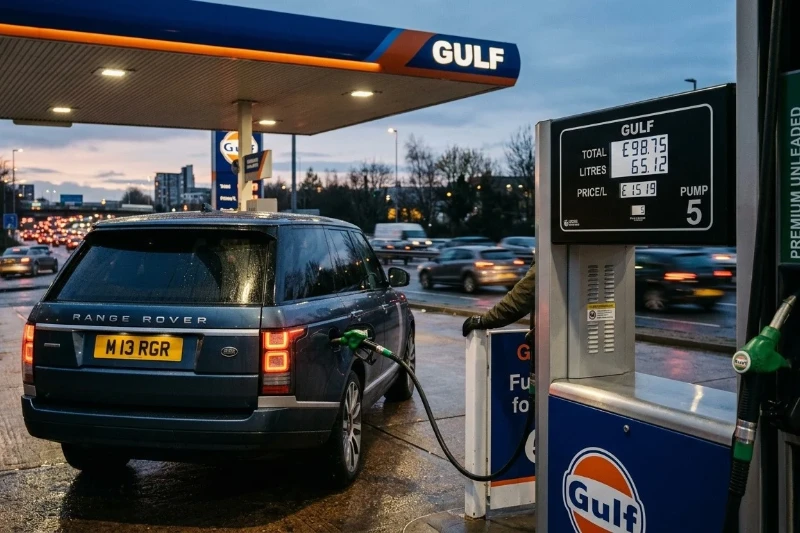
Monthly costs in USD unless stated. Utilities are for an 85 square metre (915 square foot) flat and include cooling. Broadband is unlimited data at 60 Mbps or faster. Petrol prices are the September 2026 official pump prices for 95-octane grades.
| City | Utilities | Broadband | Inexpensive restaurant meal | Petrol 95, per litre |
|---|---|---|---|---|
| UAE (Dubai) | 246 | 93 | 13 | 1.00 |
| Saudi Arabia (Riyadh) | 101 | 70 | 8 | 0.62 |
| Qatar (Doha) | 88 | 86 | 11 | 0.58 |
| Oman (Muscat) | 172 | 70 | 5 | 0.62 |
| Bahrain (Manama) | 154 | 35 | 7 | 0.66 |
| Kuwait (Kuwait City) | 66 | 30 | 11 | 0.34 |
Utilities in Dubai run to more than twice Riyadh’s, and Muscat and Manama sit well above Doha despite far lower rents. Kuwait City is the cheapest on both utilities and broadband.
Fuel is where policy shows most clearly. The pump prices behind the table are AED 3.69 for Special 95 in the UAE (Gulf News), SAR 2.33 for gasoline 95 in Saudi Arabia (ArabWheels), QAR 2.10 for Super in Qatar (Qatar Living), 239 baisa for M95 in Oman (OERLive), BHD 0.247 for Mumtaz in Bahrain (Gulf Daily News) and 105 fils for Super 95 in Kuwait, a price fixed for July to September (Arab Times). Petrol in Dubai costs about three times what it does in Kuwait City.
The UAE resets pump prices monthly against international benchmarks. Special 95 was AED 2.58 in December 2025 (Gulf News) and is AED 3.69 now, a rise of 43%. Numbeo’s Dubai page still lists AED 3.49 a litre, which matches August rather than September, a small example of how crowd-sourced prices lag official ones.
Tax, VAT and levies
| Country | VAT | Tax on salary | Other |
|---|---|---|---|
| UAE | 5% | None | |
| Saudi Arabia | 15% | None | SAR 400 a month per dependent |
| Qatar | None in force | None | |
| Oman | 5% | None until 31 December 2027, then 5% on income above OMR 42,000 a year | |
| Bahrain | 10% | None | |
| Kuwait | None in force | None |
VAT rates and the status of Qatar and Kuwait come from NUM8ERS and TaxINME, both published in mid-2026. NUM8ERS also notes that mandatory social-insurance contributions can still reduce take-home pay, so a nil income-tax rate does not mean gross pay equals net pay.
Oman’s personal income tax starts on 1 January 2028 at 5% on income above OMR 42,000 a year, about USD 109,000 according to EY. The Oman Tax Authority says about 99% of the population falls below the threshold, and lists deductions for education, healthcare, primary housing, zakat and donations.
What has changed in 2026
Riyadh: rents frozen until 2030
A five-year rent freeze took effect on 25 September 2025 for residential and commercial leases inside Riyadh’s urban boundary. According to King & Spalding, a unit under lease keeps its current rent, a previously leased unit that is vacant is fixed at the value of its last Ejar-registered contract, and a never-leased unit is priced by agreement and then frozen. Landlords can apply to challenge a frozen rent after substantial construction work or where the last contract predates 2024. Across the Kingdom, leases must be registered on Ejar and renew automatically unless one party gives 60 days’ notice. The freeze applies to Riyadh only, though the real estate regulator can extend it to other cities.
For a newcomer, the practical effect is a cap on rent rises through September 2030. The starting rent still depends on the unit and the market.
Dubai and Abu Dhabi: mixed signals
Dubai’s rent figures need care. Numbeo’s crowd data puts a one-bedroom flat at AED 5,507 a month outside the centre and AED 8,800 in the centre. Sands of Wealth, using a Dubai Land Department note and portal listings, puts the citywide one-bedroom average at about AED 6,700, with a realistic range of AED 3,200 to AED 14,000 (Sands of Wealth).
Rent indices also disagree on direction. CBRE data reported in July 2026 shows Dubai residential rents 6.2% lower in the second quarter than in the first and 2.6% lower than a year earlier, while Abu Dhabi rents were still 3.6% higher year on year (Providential Properties, summarising CBRE). Cavendish Maxwell, quoted by The National, had Dubai rents down 1.1% in the three months to May but nearly 9% higher over the year. The two use different indices and end dates. Read the Dubai figure as the middle of a wide range and get quotes for the specific areas you would consider.
Doha: rents falling, incentives rising
Knight Frank reported average apartment rents in Qatar down 13.3% quarter on quarter in the first quarter of 2026 and villa rents down 8.9% year on year, and ValuStrat’s first-quarter analysis says landlords often protect headline rents by offering grace periods rather than cutting them (Qatar Living). When comparing Doha quotes, compare the effective rent after incentives.
Food, transport and flights
Headline inflation is low across most of the Gulf, but the categories households feel are rising faster. Economist Racha Helwa notes in AGBI that Saudi consumer prices rose 1.8% year on year in July, with housing and utilities up 4.2%. Dubai’s rate was 5.3% in July, with food and beverages up 7.8% and transport up 11.9%. Qatar’s was 2.2% in June while food and beverages were up 12.7%. Her argument is that shipping-cost pressure from the Strait of Hormuz takes months to reach shelves, which is an economist’s view and not a forecast. It is a reason to leave a margin in a food budget.
Khaleej Times, citing Kamco Invest, reported Oman’s inflation at 3.2% in July, the highest in the GCC, with Kuwait at 2.2% and Bahrain at 2.3% in June (Khaleej Times via PressReader). The same report puts air passenger transport costs in Dubai 41.4% higher year on year. If your budget includes flights home, price them separately.
School fees change the family picture

For a family, schooling can rival rent. Numbeo’s average annual tuition for an international primary school in Dubai is AED 65,896, and the reported range runs from AED 40,000 to AED 110,305 (about USD 10,900 to USD 30,000). Dubai’s regulator has frozen private-school tuition for 2026-27 at 2025-26 levels (Gulf News). Registration, transport and activity charges sit outside that freeze and can still change (WhichSchoolAdvisor).
Modelled scenario: two children in international primary school, added to the family total above.
| City | Average tuition per child, per year (USD) | Two children, per month (USD) | Family total with schooling (USD a month) |
|---|---|---|---|
| UAE (Dubai) | 17,940 | 2,990 | 9,970 |
| Saudi Arabia (Riyadh) | 10,600 | 1,770 | 6,650 (includes the SAR 400 dependent levy) |
| Qatar (Doha) | 9,970 | 1,660 | 7,320 |
| Oman (Muscat) | 10,540 | 1,760 | 5,690 |
| Bahrain (Manama) | 11,000 | 1,830 | 5,990 |
| Kuwait (Kuwait City) | 9,430 | 1,570 | 5,960 |
Five of the six cities land between USD 9,400 and USD 11,000 a year, and only Dubai is well above. Muscat’s tuition is higher than Doha’s or Kuwait City’s even though its rents are a fraction of theirs, so schooling takes a larger share of a family budget where rents are lowest. Kuwait and Bahrain swap places once school fees are added, separated by about USD 30 a month, which is inside the margin of the data. Every city’s reported range is wide, and Numbeo does not say whether its family estimate already includes some education spending. If it does, these totals are overstated.
Pay changes the picture
Cheap does not mean you keep more. Numbeo also reports an average monthly net salary for each city. It is a crowd-sourced figure that mixes nationals and expatriates and public and private employers, so it is a rough guide to local pay and not a benchmark for a job offer.
| City | Numbeo average monthly net salary (USD) | Modelled single budget as a share of it |
|---|---|---|
| UAE (Dubai) | 3,550 | 75% |
| Saudi Arabia (Riyadh) | 2,070 | 84% |
| Qatar (Doha) | 3,330 | 64% |
| Oman (Muscat) | 1,670 | 80% |
| Bahrain (Manama) | 2,350 | 61% |
| Kuwait (Kuwait City) | 2,070 | 70% |
Living costs take 61% of average pay in Manama and 64% in Doha, against 75% in Dubai, 80% in Muscat and 84% in Riyadh. Oman’s low prices come with low pay. Doha is the informative case: average pay is about 6% below Dubai’s while the modelled single budget is about a fifth lower.
Which country fits which household
For a single person, Oman has the lowest modelled budget, Bahrain and Kuwait follow closely, and Doha and Dubai cost 60% to 100% more than Muscat. Pay data suggests that gap is narrower in Doha than the price gap alone implies.
For a family, Oman is lowest with and without school fees, followed by Kuwait and Bahrain. Saudi Arabia sits in the middle once the dependent levy is counted, unless the employer pays it. Qatar and the UAE cost USD 1,630 and USD 4,280 a month more than Oman for the modelled family with two children in school, so the size of a housing or education allowance matters most there.
What these figures leave out
The tables cover monthly running costs in one city per country. Other cities in each country price differently. Deposits, agent fees, and how much rent a landlord asks for up front vary by country and are outside this guide. Health insurance, car ownership and flights home are excluded, and a housing or school allowance in an offer letter changes the picture more than any national average.
Before comparing offers, rebuild the tables with the allowances in your own offer letter, then use the country pages for the detail behind each line.
Country breakdowns and comparisons
- Cost of Living in Dubai / UAE (2026 Breakdown)
- Cost of Living in Saudi Arabia (2026 Breakdown)
- Cost of Living in Qatar (2026 Breakdown)
- Cost of Living in Oman (2026 Breakdown)
- Cost of Living in Bahrain (2026 Breakdown)
- Cost of Living in Kuwait (2026 Breakdown)
- UAE vs Saudi Arabia: Which Is Cheaper to Live In?
- Qatar vs UAE: Salary and Living Cost Comparison
- Cheapest GCC Country for Families in 2026
- Cheapest GCC Country for Single Expats / Bachelors