


Key Takeaways
- Your Saudi employer applies for the work visa and later processes your iqama, the residence permit. You cannot apply for a private-sector work visa on your own.
- The Labour Law puts recruitment, work permit and iqama costs on the employer. Do not pay for the visa, and treat any request for money as a red flag.
- The route runs through the employer’s visa allocation, visa stamping at a Saudi mission in your home country, and an iqama that guides say must be issued within 90 days of entry.
- Every employment visa is classified into one of three skill tiers, and the occupation on your visa must match the work you actually do.
- Probation is capped at 90 days, and can be extended to 180 days only by written agreement made during the first 90.
- After one year of residency you can change employer through Qiwa with notice and without your employer’s consent, according to the International Labour Organization. In your first year you need consent except in limited cases such as unpaid wages or an expired permit.
- Private employers must provide health insurance from day one, including during probation.
- Domestic workers and farmers fall outside the transfer reforms.
A Saudi work visa is issued at your employer’s request and tied to your employer’s Qiwa record. This guide follows the whole route in order: eligibility and documents, the steps from job offer to iqama, the medical, costs and levies, skill tiers, contracts and probation, working hours and leave, end-of-service pay, changing employer, exit and re-entry, complaints, family and dependents, and how to avoid scams. It covers private-sector employees. For how Saudi Arabia compares with the other Gulf states, see the country-by-country work visa guide, and for the UAE and Qatar processes see how the UAE work visa works and how the Qatar work visa works.
The process at a glance
| Stage | Who acts | What happens |
|---|---|---|
| Visa allocation | Employer | Ministry of Human Resources and Social Development (MHRSD) approves the visa and the occupation |
| Contract | Employer and worker | Contract documented on Qiwa |
| Visa authorisation and stamping | Employer, then worker | Ministry of Foreign Affairs authorisation, then stamping at a Saudi mission in your home country |
| Pre-travel medical | Worker | Approved medical centre in your home country, where required |
| Arrival | Worker | Enter on the visa |
| Iqama | Employer | Issued through the passports directorate (Jawazat) and Muqeem |
| Health insurance | Employer | Cover for you and, where applicable, your family |
| Renewal | Employer | Iqama renewed through Muqeem before expiry |
Timing quoted in guides runs from four to twelve weeks for the employer-side and consular steps. Treat that as a rough range, because it depends on the employer’s visa allocation and the consulate. I found no official source that gives processing times.
Who can get a Saudi work visa
An employer, not the worker, applies. A visa guide that says it was checked against MHRSD in April 2026 states that you do not apply directly. Guides also note that employers need at least a Green rating under Nitaqat, the Saudisation compliance system, to obtain visa blocks. That is the employer’s compliance problem, but a company in a lower band may simply be unable to hire you.
A visit visa is not a route to paid work. The Ministry of Foreign Affairs warned in January 2026 that the only trusted visa site is ksavisa.sa and told the public to check links before sharing personal or financial data, as reported by Saudi Expatriates. Check the domain against the Ministry’s current announcements before using it.
Documents you will need
I found no official checklist. The only source I could read that lists the worker’s documents is a September 2026 guide from a relocation company. It lists:
- A passport valid for at least six months with two blank pages
- Two to four passport photographs on a white background
- An attested degree certificate
- An attested police clearance certificate, less than six months old
- A medical certificate from an approved centre (see below)
- The attested employment contract and the Qiwa authorisation
- Experience letters for skilled roles
The same guide does not mention professional accreditation. Health and engineering roles usually need registration with the relevant Saudi professional body, so ask your employer which body applies and who pays. I have not stated any specific accreditation rule, because I could not check the official sites.
Degree attestation
Fragomen reports that Saudi Arabia introduced an electronic degree attestation step on the Mosadaqa platform from 29 August 2023, still followed by manual attestation at the Saudi embassy in the issuing country. It started with Egypt, Jordan, Iraq and Palestine and was extended on 15 January 2024 to Bangladesh, India, Nepal, the Philippines, Singapore, Sri Lanka, Thailand, Bhutan, the Maldives, Myanmar and Sudan. Relocation guides describe the chain as your home country, the Saudi cultural attaché or embassy, then the Saudi Ministry of Foreign Affairs. Start attestation early, since skilled roles need attested degrees before the visa stage.
Step by step: from offer to iqama
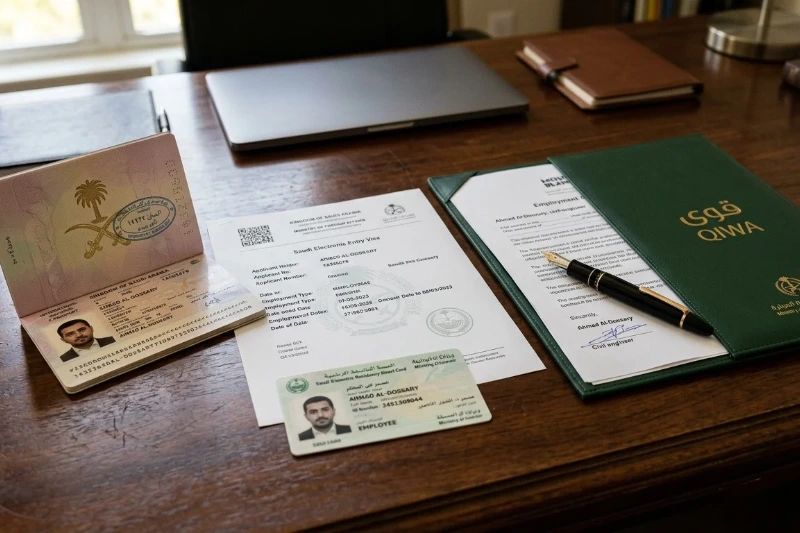
The employer starts the process. Visa Atlas lays out five stages:
- The employer obtains a visa allocation from MHRSD.
- The employer arranges visa authorisation through the Ministry of Foreign Affairs, and you have the visa stamped at a Saudi embassy or consulate in your home country with attested documents.
- After arrival you complete the steps your employer arranges, which the guide describes as a mandatory medical examination.
- The employer processes your iqama through Jawazat using the Muqeem platform, within 90 days of entry.
- The employer renews the iqama through Muqeem when it expires.
A second guide updated in September 2026 describes the same authorities (MHRSD, the Ministry of Foreign Affairs and Saudi missions abroad) and says documents must be attested and, where needed, translated into Arabic. It gives the iqama issuance deadline as 90 days from arrival and warns that late renewal can bring fines, frozen accounts or deportation. One press report, citing Jawazat, says an iqama not issued within 90 days of entry brings a SAR 500 fine on the employer.
The medical examination
Many nationalities take a pre-travel medical at an approved centre in their home country. A travel guide updated in April 2026 says the Wafid or GAMCA exam covers a clinical examination, HIV, hepatitis B and C, syphilis, malaria, a chest X-ray, and urine and stool tests, with a certificate valid for two months and a Wafid registration fee of USD 10 plus a centre fee. It gives example centre fees such as INR 7,500 to 8,500 in India, PKR 22,000 to 25,000 in Pakistan, PHP 3,000 to 5,000 in the Philippines and NPR 10,000 to 11,000 in Nepal. That source does not cover any medical after arrival, and I could not verify one officially. Ask your employer whether a second examination applies.
What it costs, and who pays
The Labour Law is clear. Article 40 puts recruitment, work permit and iqama issuance and renewal, late fines, change-of-profession fees, exit and re-entry fees and the return ticket on the employer, and the worker pays only where he is medically unfit or leaves without a legitimate reason.
The amounts below come from commercial and press sources, not official ones, so check them on Absher or Qiwa:
| Item | Amount | Source |
|---|---|---|
| Expat levy, per worker | SAR 800 a month (SAR 9,600 a year) | Saudi Scoop, Middle East Briefing |
| Dependent levy | SAR 400 a month (SAR 4,800 a year) | Saudi Scoop, Middle East Briefing |
| Iqama fee | SAR 650 a year per one source, SAR 51.75 plus service fees per another | Saudi Scoop, Middle East Briefing (conflict) |
| Transfer fee paid by the receiving employer | SAR 2,000 first, SAR 4,000 second, SAR 6,000 third and later | Middle East Briefing |
| Late iqama renewal fine | SAR 500 first, SAR 1,000 second, SAR 1,000 plus deportation third | Wego, unverified |
Health insurance
The Saudi Gazette reports that private employers must insure employees and their families from day one, including during probation, covering wives, sons up to 25 and unmarried non-working daughters, and that where both spouses work in the private sector the husband’s employer covers the children. Other advisories describe a limit of three dependents, so confirm what your policy covers.
Skill tiers and attested documents
Since July 2025 every employment visa has to be classified into one of three tiers: High-Skilled, Skilled or Basic. The registered occupation must match your actual duties, and high-skilled roles need attested degree certificates and documented experience. Middle East Briefing says the classification depends on education, experience, professional credentials, salary and age. I could not verify this against an official source. Two practical points follow. The job title on your offer letter should match the occupation Qiwa will record, and your degree needs attestation before the visa stage.
The iqama: validity and renewal
Sources differ on validity. One says the iqama is valid for one to two years, while others describe annual renewal. Fragomen reported in 2015 that the resident identity card is valid for five years and renewed electronically every year. Middle East Briefing presents a five-year card as a 2026 change, but that claim conflicts with the 2015 date, so I have not treated it as new. Read the expiry date on your own iqama record and ask your employer who tracks renewals.
A July 2026 KPMG alert says that from 1 July 2026 Qiwa automatically removes workers whose work permits have been expired for more than three months, with an exception where the iqama is still valid for 180 days or more and the employer could not renew. The employer stays liable for obligations until removal, and a grace period for correcting some expatriate statuses was extended to 31 December 2026. If your permit is close to expiry, ask your employer in writing when renewal will be filed.
Contract and probation terms
Employment contracts in Saudi Arabia are documented on Qiwa. Morgan Lewis reports that Qiwa contracts must now show a wage breakdown, social insurance (GOSI) contributions, net pay and pay dates, and that wage clauses receive an execution number, so wages can be enforced through the Najiz system without a labour court case. New contracts followed the rule from 6 October 2025, fixed-term contracts on renewal from 6 March 2026, and indefinite contracts by 6 August 2026.
On probation, the Saudi Gazette reported in October 2023 that Qiwa had tightened its contract system so probation is capped at 90 days under Article 53 of the Labour Law, with an extension to 180 days possible only by written agreement made after the contract begins and within the original 90 days. MHRSD’s guidance says either party may end the contract during probation unless the contract gives that right to one side only, and that neither side owes compensation and the worker gets no end-of-service award. It adds that Eid holidays and sick leave are not counted toward the probation period and that an employer cannot put you on probation twice unless the job differs or at least six months have passed since the previous employment ended. This MHRSD article dates from 2019, so check it against the current Labour Law text. Middle East Briefing (November 2025) says workers who resign in probation should still honour the contractual notice period or risk liability.
Two more terms need a read before you sign. Article 83 makes a non-compete valid only if it is written and specific about time, place and kind of work, for at most two years. Confidentiality also needs to be written. The August 2024 amendments also say contracts must be documented under the regulation, and Roedl’s summary adds that an indefinite contract defaults to one year in some cases.
Working hours, leave and end-of-service pay
These standards come from the Labour Law text and HRSD guidance, so check them against your contract:
- Working hours: HRSD’s knowledge page (2019) says eight hours a day or 48 a week, and six hours a day or 36 a week in Ramadan for Muslims (HRSD). The English Labour Law PDF on the HRSD site says nine hours a day or 45 a week in Article 98. The two official texts differ, so ask your employer which applies to your contract.
- Overtime (Article 107): the hourly wage plus 50% of basic wage. Under the amendments, overtime can be compensated with paid leave by agreement. Work on holidays counts as overtime.
- Annual leave (Article 109): 21 days, rising to 30 days after five consecutive years. It cannot be swapped for cash during service.
- Sick leave (Article 117): 30 days on full pay, the next 60 days at three-quarters pay, and the next 30 days unpaid, in each year counted from the first sick leave.
- Maternity and family leave: Roedl’s April 2025 summary of the amendments lists 12 weeks of maternity leave (six mandatory), three days of paternity leave within seven days of birth, and three days for the death of a sibling.
- End-of-service award (Article 84): half a month’s wage for each of the first five years, and one month for each year after. If you resign (Article 85), you receive one third of the award after two to five years, two thirds after five to ten years, and the full award after ten years.
Notice and resignation
The original Article 75 gave 60 days’ notice for monthly-paid workers. The amended version, described in HRSD’s August 2024 guide, gives workers 30 days and employers 60 days on indefinite contracts. A new Article 79 bis says a resignation is deemed accepted if the employer does not respond within 30 days, and the employer may defer it up to 60 days with written reasons. Compensation for an invalid termination under Article 77 is 15 days’ wage for each year on an indefinite contract, or the remainder of a fixed-term contract, with a minimum of two months.
Changing employer

The International Labour Organization’s November 2025 paper on Saudi Arabia describes the Labour Reform Initiative, in force since March 2021 under a ministerial resolution of November 2020 (ILO). It says:
- After one year of residency, workers can change employer with notice and without the current employer’s consent. The paper gives 90 days as the notice period.
- In the first year, a transfer needs the employer’s approval except in limited cases such as an expired residency or work permit, three consecutive months of unpaid wages, or an employer intentionally delaying labour disputes.
- Workers can request exit and re-entry visas themselves through Absher, but employers can still issue a final exit visa during the contract, which the paper says obliges the worker to leave within 60 days.
- The reforms exclude domestic workers and farmers.
A practitioner guide from 2025 describes the steps on Qiwa: the new employer submits the transfer request, the worker accepts within 10 days, the current employer has 14 days to respond, and a notice period of up to 60 days may apply. It also lists grounds for transfer without consent, including three months of unpaid salary, an expired permit, breaches of labour or Saudisation rules, and failure to register the contract on Qiwa. It says a worker holding a final exit visa cannot transfer.
The 60-day and 90-day figures come from different rules and different sources. In the HRSD’s 2022 procedural guide, 60 days is the window after an absence report to complete a transfer (with a maximum of two transfer attempts and 15 days to complete each), and the amended Article 75 gives employers 60 days’ notice (HRSD procedural guide). The 90-day figure in the ILO paper is a description of the transfer notice, and I could not find it on an official Saudi page. Confirm the notice that applies to you on Qiwa and in your contract before you resign.
MHRSD confirms that the transfer service runs through Qiwa and lets an employer request the transfer of an expatriate’s services without visiting the ministry. The page gives no conditions.
Exit, re-entry and final exit
Workers can request exit and re-entry visas through Absher. A travel guide quotes SAR 200 for a single exit and re-entry visa valid up to two months plus SAR 100 for each extra month, and SAR 500 for a multiple visa for three months, plus SAR 200 for each extra month, with penalties of SAR 1,000, 2,000 and 3,000 for issuing a visa and not travelling. It also reports that the three-year re-entry ban was lifted on 16 January 2024. Under Article 40 the employer pays these fees. I could not open the official service page, so treat the amounts as guides.
Trade press also reports a 60-day window in 2026 for fixed-term workers to find new sponsorship, renew or exit after a contract ends. Check this on Qiwa before relying on it.
Absence reports
If an employer reports a worker absent, Saudi Expatriates, citing Jawazat, says the worker is automatically removed from the employer’s records. The HRSD’s 2022 guide gives a 60-day window after such a report to transfer to a new employer. If your employer files a report you believe is false, contest it through MHRSD’s complaint route below and keep evidence that you attended work.
Passport retention
Employers may not hold your passport, iqama or insurance card. A guide updated in August 2026 cites Article 6 of the implementing regulations, and lists the routes as an MHRSD violation report, a friendly settlement and the 19911 hotline. It states no penalty. Keep copies of your passport and iqama.
Where to complain
The Indian embassy in Riyadh describes the Saudi grievance route: call MHRSD’s toll-free 19911, and the first stage is an amicable settlement at the labour office, with referral to court after 21 working days. Clyde & Co describes two sessions within 21 working days, a filing deadline of 12 months from the termination or violation, and an appeal within 30 days. Keep your contract, payslips, bank statements and messages about pay. I found no source on the Wage Protection System payment rules, so ask your employer to show that your salary is paid through it.
Family and dependents
I found no official source giving the salary or profession requirements for sponsoring a spouse and children, or the rules for family visit visas, so I have not stated any. Ask your employer or an Absher service centre before you accept an offer if your family will join you. Two facts are sourced. The dependent levy is quoted at SAR 400 a month (see costs), and MHRSD’s 2024 initiative lets dependents aged 18 or over with valid residency and professional qualifications work in the health and education sectors on a free permit, provided the employer is registered, has an active commercial registration and is not in the red Nitaqat band. Middle East Briefing says spouses and adult children can obtain separate work permits more widely in 2026, but that conflicts with the 2024 initiative and I could not confirm it.
Scams and fake offers
Anyone asking you to pay for a visa, medical or iqama is asking for something the Labour Law puts on the employer. Check that the employer exists, that a visa allocation has been issued in your name, and that any link you are sent goes to an official government domain. The Ministry of Foreign Affairs warning above says to verify links before sharing personal or financial data.
Final word
The Saudi system puts the visa and iqama in your employer’s hands and, under Article 40, the costs too. What protects you is the Qiwa contract: check the job title, salary, probation and notice terms before you travel, keep your own copies, and never pay for the visa. Since the Labour Reform Initiative you can change employer after a year without consent, but you should confirm the notice that applies and never let an iqama or work permit lapse, because Qiwa now removes workers whose permits stay expired. Rules, fees and processing steps change often, so confirm the current position on Qiwa, Absher and the MHRSD site before you act.
Frequently asked questions
Can I apply for a Saudi work visa myself?
No. Your employer requests the visa allocation and processes the iqama. You supply documents, attend the medical and have the visa stamped.
Do I have to pay for my visa or iqama?
Article 40 of the Labour Law puts recruitment, work permit and iqama costs on the employer. Ask who pays the medical and dependent costs and get the answer in the offer letter.
How long does the iqama take?
Guides say the employer must issue it within 90 days of entry. I found no official processing time for the visa stage, and guides quote four to twelve weeks.
Can I change employer without my employer’s consent?
After one year of residency, yes, through Qiwa with notice, according to the ILO. In the first year you need consent except in limited cases such as unpaid wages or an expired permit.
How much notice must I give?
The amended Labour Law gives workers 30 days and employers 60 days on indefinite monthly-paid contracts. Transfer notice may differ, so check Qiwa and your contract.
How long is probation?
Up to 90 days, extendable to 180 days only by written agreement made within the first 90.
What happens if my employer does not pay me?
Call MHRSD on 19911 or use the labour office. Three consecutive months of unpaid wages is one of the grounds for transferring without consent.
Can I bring my family?
Possibly. I could not find official requirements, so ask your employer and check Absher. The dependent levy is quoted at SAR 400 a month.
Checks before you accept an offer
- Ask for the offer letter with the job title, salary and probation length, and check that they match what your employer will register on Qiwa.
- Confirm which tier your role will fall into, and what degree attestation and experience letters you need before the visa stage.
- Ask who pays the visa, medical, levy and iqama costs and who tracks your iqama expiry. Also ask about dependent levies if your family will join you.
- Ask about the notice period in your contract, and whether the employer expects you to serve it if you transfer.
- Check the probation length is no more than 90 days and that any non-compete meets Article 83.
- Ask for your health insurance details, including whether your family is covered.
- Confirm your salary will be paid through the Wage Protection System and appear on Qiwa.
- Keep your own passport and copies of your contract and iqama.
- Check your own status on Qiwa and Absher instead of relying only on your employer’s representative.