


Key takeaways
- Your employer must obtain the work permit and residence visa, in this order: job offer, signed contract, work permit, work visa. You cannot apply for a standard employment visa yourself.
- The law bars employers from charging you recruitment fees, directly or indirectly. Anyone asking you for money to secure a job is a red flag.
- The standard employment visa lasts two years. The employer pays the work permit fee, which the government portal puts between AED 250 and AED 3,450 depending on the company’s classification.
- You need a medical fitness test (HIV and TB screening) and an Emirates ID. Commercial guides quote roughly AED 250 to AED 350 for the standard medical.
- Probation lasts up to six months. Leaving it for another UAE employer needs one month’s notice, or 14 days if you leave the country. After probation, notice must be between 30 and 90 days.
- A one-year work permit ban applies in defined cases, mainly leaving during probation without the required notice or an approved absence-from-work complaint. The government portal and MoHRE’s 2026 guidance describe the grounds differently.
- After your visa is cancelled you get a grace period of 30 days for most workers, and longer for some categories.
- To sponsor your family, the government portal states a minimum salary of AED 4,000, or AED 3,000 plus accommodation.
To work in the UAE private sector, your employer must obtain a work permit for you and then a residence visa. You cannot apply for a standard employment visa yourself, and the law bars an employer from charging you recruitment fees. What you control is what you sign and how you leave, because probation and notice terms decide whether a job change costs you a one-year work permit ban. This guide follows the whole route in order: eligibility, documents, the visa steps, medical test and Emirates ID, costs, contracts and pay, working hours and leave, probation and notice, changing jobs, unemployment insurance, free zones, family sponsorship, what happens when your visa is cancelled, and how to spot a scam.
It covers private-sector employees of mainland companies and, where noted, free zones. Domestic workers, government staff, freelancers and self-sponsored residents such as Golden Visa and Green Visa holders follow different rules. For how the UAE compares with the other five Gulf states, see the country-by-country work visa guide.
The process at a glance
| Stage | Who acts | What happens |
|---|---|---|
| Job offer | Employer and worker | A formal offer letter with the main terms |
| Contract | Employer and worker | Written contract signed by both sides |
| Work permit | Employer | MoHRE (or the free zone authority) issues the permit |
| Entry permit or status change | Employer | Entry permit if you are abroad, status change if you are already in the UAE |
| Medical fitness test | Worker | Screening at an approved centre |
| Emirates ID and biometrics | Worker | Fingerprints and signature at an ICP service centre |
| Residence visa | Employer | Visa issued and stamped or issued electronically, valid up to two years |
| Wages | Employer | Paid on the due dates through the Wage Protection System |
The government portal states that the order is fixed. Timings vary by emirate and employer, so treat any time quoted below as a rough range.
Who can get a UAE work visa
The UAE government portal describes the employment process as a formal job offer, a signed employment contract, a work permit, then a work visa. It also says that once you have signed, the employer cannot change the offer letter’s provisions unless you consent and the change is within the law.
Three points decide whether you can be hired:
- The employer must hold a valid trade licence and be registered with the Ministry of Human Resources and Emiratisation (MoHRE). The role has to match the company’s licensed activity.
- Workers must be at least 18, with limited exceptions for juveniles and students in training.
- A visit visa does not authorise work. MoHRE’s guidance, as reported by Gulf News in August 2026, warns jobseekers that a genuine offer comes with an official work entry permit, and that visit visas are not a route to a job.
The government portal lists 13 work permit types. The one most new hires need is the permit to recruit a non-UAE worker, valid for two years.
Documents you will need
The government portal’s page on the work visa is an overview and does not list documents. The ICP residence permit service says the passport must be valid for at least six months. A June 2026 guide from a global employment platform adds educational certificates, the employment contract, and a medical test. So the practical list is:
- a passport valid for at least six months
- your signed employment contract and offer letter
- educational certificates, attested where the role or the employer requires it
- passport-size photographs, as the visa application normally asks for them
- the medical fitness result, obtained after the application is filed
I found no official source that requires a police clearance certificate for a standard private-sector visa. Some employers or free zones ask for one, so ask yours.
Degree attestation
Attestation is needed for regulated professions and by some employers, not for every job. The route described by Khaleej Times runs through the home-country notary, the foreign ministry there, the UAE embassy, and then the UAE Ministry of Foreign Affairs. A commercial guide from August 2026 quotes AED 150 per document at the Ministry of Foreign Affairs and two to four weeks for the whole chain, and says healthcare, engineering, teaching, legal and academic roles are the ones that need it. Treat those fees as unverified.
Fragomen adds that the Ministry of Education equivalency check applies to higher-education admission, professional licensing, changes of job title and the Golden Visa, and it does not list it for a general employment visa (Fragomen). Ask your employer, before you resign from your current job, whether your role needs attested documents and who pays.
Step by step: how the visa is issued
The work permit comes first. Federal Decree-Law No. 33 of 2021 says an employer may not recruit or employ a worker without a permit from MoHRE, and that the employer cannot charge the worker recruitment fees (Articles 6(1) and 6(4), UAE Legislation).
After that, the residence stage runs as follows, based on one immigration adviser’s summary and the official pages:
- The employer applies for the work permit and, once approved, issues the entry permit. If you are outside the UAE, this employment entry permit is officially valid for 60 days from issuance to enter the country.
- If you are already in the UAE on another visa, the employer arranges a change of status instead. The ICP service fee for a status change is AED 500.
- You take the medical fitness test.
- You register your biometrics for the Emirates ID at an ICP service centre within your 60-day entry permit window to ensure medical screening and residency stamping are completed on time.
- The residence visa is issued. The government portal confirms a standard employment visa is valid for two years.
How long it takes
The government portal says MoHRE’s Work Bundle cut work permit processing from 30 working days to five, and in-person visits from seven to two. The ICP page puts the residence permit service at two days. Commercial guides describe the whole journey as longer, for example four to five weeks for a standard permit. The official figures describe individual government steps, and the commercial ones describe the end-to-end experience, so plan on weeks from signing to a residence visa.
The medical fitness test

The test is part of the visa stage. According to Emirates 24|7 (April 2026, modified June 2026), the screening covers HIV and tuberculosis; syphilis and hepatitis B apply to certain occupations; and a chest X-ray is needed for new visas in Abu Dhabi and Dubai. It quotes AED 250 to AED 350 for the standard service with results in 24 to 48 hours, and a faster service at a higher price.
Two rules matter if a result is not clear. Emirates 24|7 says that for active or drug-resistant TB, a conditional fitness certificate and a one-year residence visa can be issued with treatment inside the UAE. A commercial guide says an HIV result is an automatic denial, with 14 days to appeal and a confirmatory test seven to ten days after a reactive result. The two sources describe different conditions, so if a result worries you, ask the centre for the procedure in writing.
Emirates ID
Anyone aged 15 or over gives fingerprints and a signature at an ICP service centre, and you apply through the ICP website or a typing centre. The government portal describes an urgent 24-hour service. The ICP service page lists an application fee of AED 100 and delivery by courier. The portal does not state a deadline for biometrics, so do it as soon as your employer tells you the file is ready.
What it costs, and who pays
The law is clear on the principle. Article 6(4) of the Decree-Law prohibits the employer from charging the worker the fees and costs of recruitment, and Gulf News quotes MoHRE saying employers cannot charge workers recruitment costs directly or indirectly. The employer holds the permit and pays for it.
The figures below come from mixed sources, so check which are official:
| Item | Amount | Source type |
|---|---|---|
| Work permit | AED 250 to AED 3,450, by company classification | Official (u.ae) |
| ICP application | AED 100 | Official (ICP) |
| Residence permit, per year | AED 100 | Official (ICP) |
| Smart service fee | AED 100 | Official (ICP) |
| Status change | AED 500 | Official (ICP) |
| Financial guarantee | AED 3,000 to AED 5,000 depending on category | Official (ICP), stated generally |
| Medical fitness test | About AED 250 to AED 350 standard | Press (medical test report) |
| Total government charges | AED 2,000 to AED 7,000 | Commercial estimates |
A July 2026 commercial estimate puts the whole cost at AED 3,500 to AED 6,000 for a free zone hire and AED 5,000 to AED 7,000 for mainland, including health insurance. Use those as a sense of scale. Ask your employer which of these it covers, and get the answer in the offer letter.
Scams and fake job offers
MoHRE’s guidance says scammers ask for money for visas, medicals or registration. A genuine offer can be checked on the MoHRE website or app, and it carries a serial number and barcode. Gulf News, reporting the guidance in August 2026, gives 600 590000 as the MoHRE call centre and 800 2626 for Aman, the Abu Dhabi Police fraud reporting service. A separate October 2025 report advises checking the company in the National Economic Register and insisting on an official work entry permit (Gulf News). Before paying anyone, confirm the employer exists and that a permit has been issued in your name.
What your contract and probation terms decide
Decree-Law 33 of 2021 sets the ground rules, and the terms that matter when you leave are these:
- The contract must be in writing, in two copies. Fixed-term contracts are allowed, and if both sides keep performing after the term ends without a new agreement, the contract is treated as extended (Article 8).
- Probation lasts six months at most, and a worker serves only one probation period with the same employer. During probation the employer can end the contract with 14 days’ written notice (Article 9).
- If you move to another employer during probation, you must give one month’s notice, and the new employer compensates the old one for recruitment costs (Article 9(3), as summarised on the legislation portal).
- After probation, the notice period must be at least 30 days and no more than 90. The party who does not serve it owes the other a payment equal to the full wage for the notice period (Article 43).
- A non-compete clause can last at most two years and must be specific about time, place and kind of work. It is void if the employer terminates you wrongfully (Article 10).
Before you sign, read the probation clause, the notice period and any non-compete, and check that the salary, allowances and job title match your offer letter.
Working hours, leave and end-of-service pay
These standards come from the Decree-Law, with article numbers as summarised on the legislation portal (UAE Legislation):
- Working time is eight hours a day or 48 hours a week (Article 17). During Ramadan, MoHRE mandates a statutory two-hour daily reduction in standard working hours for private-sector employees.
- Overtime carries a premium of at least 25%, and night work between 10pm and 4am at least 50%, with limits of two hours a day (Article 19).
- Workers get at least one paid weekly rest day (Article 21).
- Annual leave is 30 days for each year of service, with pay (Article 29).
- Sick leave is 15 days on full pay, then 30 days on half pay, then unpaid, up to 90 days a year (Article 31).
- Maternity leave is 45 days on full pay plus 15 days on half pay (Article 30).
- The end-of-service gratuity for a full-time worker with a year or more of service is 21 days of wages for each of the first five years and 30 days for each year beyond that, capped at two years of wages (Article 51). Confirm how your employer calculates the base wage before you sign.
Article 22 requires wages to be paid on the due dates through the Wage Protection System (WPS). If an employer delays salary payments, MoHRE automatically restricts the company’s file and blocks new work permits until all dues are cleared.
Where to complain if you are not paid
A commercial guide describes the MoHRE route: file for free through the MoHRE app or website with UAE Pass, or at a Tasheel centre. MoHRE aims to settle, decide or refer the case within 14 days, its decision is binding for claims up to AED 50,000, and larger claims go to court. The same source gives 80084 as the call centre number, while Gulf News gives 600 590000, so use the number on the official MoHRE site. Keep your contract, payslips and bank statements, since those are the evidence you will need.
Passport retention
Employers may not keep your passport. Mondaq’s June 2026 legal note says Article 13 of the Decree-Law bars an employer from withholding a worker’s official documents, with a limited exception for temporary holding while visa and permit processing is under way, followed by immediate return. I did not check the article number in the statute text. If your employer refuses to return your passport after processing, report it to MoHRE.
Changing jobs and the one-year ban
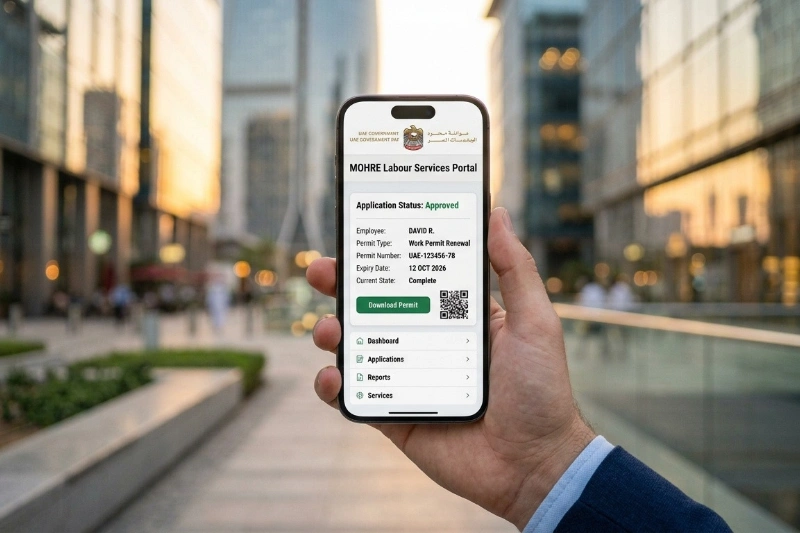
Most job changes need no permission from the current employer. MoHRE said in May 2026 that workers can move without restriction when the contract expires or ends by mutual agreement. The same report says a one-year ban on new work permits applies in two situations:
- You leave during probation without giving the required notice: one month if you stay in the UAE, 14 days if you leave the country.
- An employer’s absence-from-work complaint against you is approved by MoHRE as valid.
The UAE government portal lists three grounds instead: ending the contract during probation when the employer has met its obligations, a proven absconding report, and a permit cancelled at a fictitious establishment. The portal also lists exemptions from the ban for proven absconding: workers on family residence visas, those renewing with the same employer, specialised professionals the UAE needs, and Golden Visa holders. The ban period starts when the worker leaves the UAE and lifts automatically at the end. A worker can contest a ban with MoHRE by showing it was unjustified.
The two accounts overlap but are not identical. The 2026 clarification puts the emphasis on notice: serve the right notice in probation and the ban does not apply. The portal’s wording refers to ending the contract in probation when the employer has honoured its obligations. Commercial commentary from May 2026 adds that a previous employer may claim recruitment costs if you leave and return within three months, but I could not verify that against MoHRE. If you plan to move in your first six months, get the notice terms and the new employer’s willingness to compensate in writing, and confirm your case with MoHRE. A May 2026 Khaleej Times report says job transfers take two to four weeks once notice and documents are in place.
Unemployment insurance
Employees in the federal government and private sectors must subscribe to involuntary loss of employment (ILOE) insurance. A commercial compliance provider reports it is the employee’s responsibility to subscribe and keep it paid, with a fine of AED 400 for not subscribing and AED 200 for missed premiums (UAE PRO Services, 10 August 2026). Another commercial guide from August 2026 says the premium is AED 5 a month for category A (salary up to AED 16,000) and AED 10 a month for category B, plus VAT (UAE Expert Hub). Vialto’s immigration alert says ILOE confirmation is required before a labour card is issued for new and renewed mainland permits since January 2024. The providers list exemptions for business owners working in their own establishments, domestic workers, temporary-contract staff, people under 18 and pensioners in new employment, and say unpaid dues can hold up a new permit when you change employer. Check the amounts and exemptions on the official ILOE service before relying on them.
Free zones and financial centres
Free zone companies sponsor visas through their own authority rather than through MoHRE, so the application steps, contract templates and complaint routes differ by zone. Zoho’s payroll guide notes that Decree-Law 33 of 2021 applies to both mainland and most free zones, but that the financial centres DIFC and ADGM have independent employment laws, and that working outside your sponsoring jurisdiction may need additional permits. If your offer comes from a free zone company, ask which authority issues your visa and which rules govern probation and notice. I could not find an official rule on moving between a free zone and the mainland, so ask the new employer to confirm the steps before you resign.
Sponsoring your family
The government portal says a resident can sponsor family with a minimum salary of AED 4,000, or AED 3,000 plus accommodation, and that family members aged 18 or over must pass a medical test. The page carries no date, so confirm the figures with ICP before you commit.
A commercial guide, updated in August 2026, describes the process: open a sponsor file, obtain an entry permit or status change, take the medical test, register for Emirates ID and have the visa stamped. It lists an attested marriage certificate, a tenancy contract (Ejari) or title deed, and a salary certificate as the usual documents, and a refundable deposit of AED 1,020 (AED 2,020 for second-degree relatives). The same source gives higher thresholds for female sponsors and for parents, which I could not confirm officially, so I have left them out. A dedicated guide on family sponsorship is planned for this cluster.
After your visa is cancelled: the grace period
Once your employer formally cancels your visa, the UAE provides a tiered grace period to find a new sponsor, switch to another visa type, or exit the country:
- 180 days: Golden, Green, and Blue visa holders, students post-graduation, and specific humanitarian categories.
- 90 days: Skilled professionals categorized under MoHRE Skill Levels 1, 2, and 3 (managers, engineers, executives, technicians) and property owners.
- 30 to 60 days: Standard and unskilled employment categories (Skill Levels 4 and 5).
Overstaying your assigned grace period carries a standardized fine of AED 50 per day. Always confirm your exact expiry date on the ICP Smart Services portal (or the GDRFA app for Dubai-issued visas) the day your cancellation is processed.
Final word
The UAE process is largely in your employer’s hands, which is why what you sign matters most. Read the probation, notice and non-compete terms before the permit is applied for, never pay a recruitment fee, and keep your passport and your own copies of every document. When you leave, serve the notice the contract requires, because that is what protects you from a one-year work permit ban, and check your grace period as soon as your visa is cancelled. Rules, fees and processing steps change often, so confirm the current position with MoHRE and ICP before you act.
Checks before you accept an offer
- Get the offer letter and contract in writing before any permit is applied for, since the sequence starts with the offer and contract.
- Read the probation clause: length, notice, and what happens if you move to another UAE employer.
- Confirm the notice period is between 30 and 90 days and check any non-compete for its length and scope.
- Ask whether the employer is mainland or free zone, and who issues your residence visa.
- Ask which costs the employer covers, and confirm nobody is asking you to pay recruitment fees.
- Ask whether your role needs attested certificates and who pays for them.
- Confirm the salary and allowances, and check whether they meet the family sponsorship threshold if you plan to bring your family.
- Ask who registers you for ILOE insurance and the health insurance your emirate requires.
- Keep your own passport and copies of your contract and permit.
- Check your permit and visa status on the official MoHRE and immigration services, not only through the employer’s PRO.
Frequently asked questions
Can I apply for a UAE work visa myself?
No. Your employer applies for the work permit, and the residence visa follows. Self-sponsored routes such as the Golden Visa and Green Visa are separate and have their own eligibility rules.
Do I have to pay for my visa or the recruitment?
The law bars employers from charging workers recruitment fees. Ask which costs the employer covers, including the medical and Emirates ID, and get the answer in the offer letter.
How long is a UAE work visa valid?
The government portal says a standard employment visa is valid for two years, and it can be renewed.
How long does it take?
Official pages describe five days for the work permit and two days for the residence permit service. Commercial guides describe four to five weeks end to end, so plan for weeks and ask your employer for a timeline.
Can my employer stop me changing jobs?
Not by refusing an NOC in most cases. You can move without restriction when the contract expires or ends by mutual agreement. A one-year ban applies in the cases described above, so serve the notice your contract and the law require.
How much notice must I give?
After probation the notice period must be between 30 and 90 days. During probation, moving to another UAE employer needs one month’s notice, or 14 days if you leave the country.
What happens if my employer does not pay me?
File a complaint with MoHRE through its app, website or a Tasheel centre. Keep your contract, payslips and bank statements.
How long can I stay after my visa is cancelled?
Thirty days for most workers, with longer periods for some categories. Check your deadline on ICP Smart Services.
Can I bring my family?
Yes, if you meet the salary requirement, which the government portal states as AED 4,000 or AED 3,000 plus accommodation. Family members aged 18 or over need a medical test.